


If your playlist feels a bit flat on a TV stand or a work desk, a good pair of bookshelf speakers can be the single biggest upgrade you make. We put together this Canada-focused roundup to help you pick a model that fits your space, sources, and listening style without guesswork.
In this guide, we compared 10 wired and powered options by looking at real-world fit: connection options, ease of setup, size for desks or stands, and the kind of sound signature each one is known for. The goal is simple: help you choose confidently whether you are building your first stereo or tightening up a small living-room system.
Below are our picks, followed by a quick methodology and a deeper buying guide so you can match the right speakers to your gear.
- Powered or passive Powered speakers simplify setup, while passive speakers let you choose an amp and upgrade later.
- Inputs matter For TVs, look for optical; for a turntable, you may need a phono preamp or a speaker that includes one.
- Size vs bass Bigger cabinets tend to sound fuller, but small rooms and desks often benefit from compact near-field models.
- Placement wins A great pair can sound average if they are too close to walls or not aimed at your listening position.


How We Chose These Bookshelf Speakers
To shortlist these bookshelf speakers, we compared core specs, features, and consistent patterns in public owner feedback, with an emphasis on Canadian living rooms, desks, and small apartments. We prioritized models that cover the most common use cases: TV audio, computer listening, and simple two-channel music.
We also balanced passive and powered options so you can choose between a clean, minimal setup or a more upgradable system with a separate amplifier. Finally, we looked for practical wins like useful inputs, sensible cabinet sizing, and straightforward controls.
What to Look for in Bookshelf Speakers
This decides your whole system layout, from cabling and volume control to upgrade paths and overall value.
Your TV, computer, and turntable each need specific connections, and adapters can add noise or complexity.
Bookshelf speakers are sensitive to distance, toe-in, and wall proximity, which affects bass and imaging.
Near-field desk listening needs controlled treble and tight imaging, while living rooms benefit from more output headroom.
Before you buy, check where your volume will be controlled. Some powered speakers expect you to adjust volume on the speaker itself, which can be awkward across the room.
01
Warm sound with Bluetooth
We like the Edifier R1700BT for Canadian setups that need easy Bluetooth, a handy remote, and a classic wood-look cabinet. Reviews consistently call out rich, clear sound that feels big for the price.
- Bluetooth for easy pairing
- Remote and side controls
- Warm, clear sound
- Wood look is vinyl
- Standby not true off
The Edifier R1700BT is a strong all-around pick for bookshelf speakers when you want powered, near-field sound without overcomplicating your setup. We see consistent feedback around deep, rich audio and good clarity, especially for music and movies in smaller rooms. Bluetooth makes casual listening simple from phones, tablets, or computers, and the included remote plus side-panel EQ knobs let you tweak volume and tone quickly. The MDF cabinet with walnut-effect finish also blends nicely into most home decor.
02
Vinyl-ready powered speakers with Bluetooth
We like how Kanto YU6MB bundles a built-in phono preamp, aptX Bluetooth, and a handy remote into a clean powered bookshelf setup, making it a simple match for turntables and everyday streaming.
- Built-in phono preamp
- aptX Bluetooth streaming
- Remote with tone controls
- No built-in voice assistant
- Occasional standby quirks reported
Kanto YU6MB is a powered bookshelf speaker pair that’s easy to build around, especially if you’re mixing vinyl and streaming. The integrated phono preamp lets you plug in many turntables directly, while Bluetooth with Qualcomm aptX keeps casual listening convenient. We also appreciate the included remote for volume, input, and tone adjustments from your seat. The MDF cabinets house 1 inch silk dome tweeters and 5.25 inch Kevlar drivers for a balanced, room-friendly presentation.
03
Dynamic, detailed horn-loaded sound
We like how the Klipsch RP-600M II blends a lively, detailed top end with efficient output and punchy bass for its size. Bi-wire/bi-amp terminals and a magnetic grille make setup and styling feel properly hi-fi.
- Clear, detailed horn treble
- Efficient, room-filling output
- Bi-wire and bi-amp ready
- Treble can sound bright
- Made in China
The Klipsch RP-600M II is a bookshelf speaker built around a larger 90 x 90 Tractrix horn and a 1 inch LTS titanium tweeter, aiming for crisp, low-distortion detail with wide dispersion. A 6.5 inch Cerametallic woofer and rear Tractrix port help it deliver fast, clean bass energy for its cabinet size. We also like the dual binding posts for bi-wiring or bi-amping, plus the furniture-grade finish and magnetic grille for a tidy look.

Warm sound with punchy bass
Polk Signature Elite ES15 is a compact bookshelf speaker pair tuned for clear, warm listening with surprisingly solid bass for the size. It is easy to match with most AVRs and can also wall-mount for flexible placement.
- Warm, musical sound
- Surprisingly strong bass
- Easy amplifier compatibility
- Wall mounting needs careful placement
- Stands sold separately
Polk Signature Elite ES15 is a compact bookshelf speaker pair that balances detail and body, making movies and music sound lively without getting fatiguing. We like that it pairs easily with a wide range of amplifiers and AV receivers thanks to its 4 and 8 ohm compatibility and high sensitivity. Power Port bass tuning helps add weight and impact for its size, and the cabinet includes keyhole slots so you can wall-mount when shelf or stand space is limited.

Easy dual-input desktop speakers
We like Edifier R1280T for simple, great-sounding stereo in a small room. You get dual AUX inputs for two sources at once, plus a remote and side EQ knobs for quick volume, bass, and treble tweaks.
- Dual AUX inputs
- Clear, balanced stereo sound
- Remote plus side EQ
- Bass may feel light
- No Bluetooth connectivity
Edifier R1280T is a straightforward powered 2.0 bookshelf speaker set that works well on a desk, in a bedroom, or as a TV upgrade. We see consistent praise for crisp, natural sound from the silk-dome tweeter and 4-inch driver, with simple controls that make daily use painless. Dual AUX inputs let you keep two sources connected without swapping cables, and the included remote handles volume while the side knobs dial in bass and treble to taste.

Near-field monitors for desks
We like how the Edifier MR4 brings a more monitor-style, near-flat sound to a compact desktop setup. With multiple inputs and a headphone out, it fits nicely for both casual listening and basic creation work.
- Balanced TRS and RCA inputs
- Monitor and Music modes
- Front headphone output
- 4-inch woofer limits bass
- No Bluetooth or wireless
The Edifier MR4 is a powered near-field pair that slots neatly into a Canadian desk or small-room setup when you want a clearer, more honest presentation than many typical bookshelf speakers. We appreciate the dual Monitor and Music modes, plus the separate high and low knobs for quick tuning. Connections are flexible for the price, including balanced 1/4-inch TRS, RCA, and AUX, and the front headphone output is genuinely convenient for late-night listening.

Desktop monitors with Bluetooth
JBL 104-BT is a compact pair of desktop reference monitors that slots into small spaces while giving you Bluetooth plus TRS, RCA, and 3.5 mm connectivity for easy switching between sources.
- Bluetooth 5.0 streaming built in
- TRS, RCA, and aux inputs
- Compact desktop-friendly footprint
- Bass can sound light
- Occasional noise or QC complaints
JBL 104-BT is a compact, coaxial-driver speaker pair aimed at nearfield listening on a desk, whether you are mixing, editing, or just streaming music. We like the flexibility of Bluetooth 5.0 alongside TRS, RCA, and 3.5 mm inputs, which makes it easy to integrate with interfaces, computers, and media players. Reviews often praise the punchy output for the size, but some listeners find the low end lean, and a few report quality issues like noise or hardware problems.
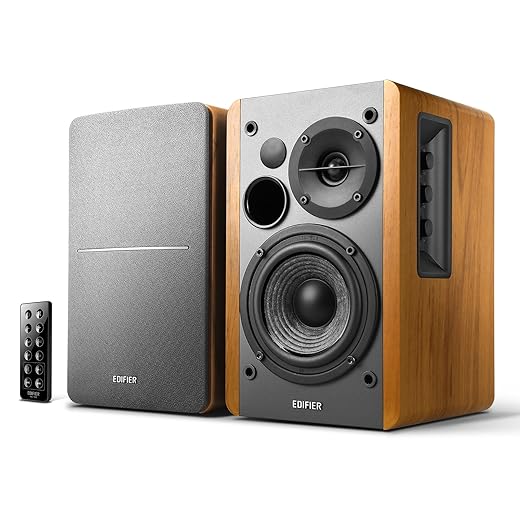
Easy wireless speakers for TV
We like the Edifier R1280DB for compact, no-fuss desktop or TV audio. You get Bluetooth plus optical and coaxial digital inputs, along with a handy remote and onboard bass and treble controls.
- Bluetooth plus digital inputs
- Remote with input switching
- Compact desk-friendly footprint
- Bass limited by 4 inch woofer
- Controls on main speaker side
The Edifier R1280DB is a straightforward powered bookshelf speaker set that fits nicely on a desk or under a TV. We see consistent praise for its sound quality and simple setup, and the feature mix is strong for the price: Bluetooth for casual streaming, plus optical and coaxial inputs for a clean digital connection to TVs and computers. A remote handles volume and input switching, while bass and treble knobs on the main speaker let you fine-tune the voicing to your room.

Detailed hi-fi for movies
We like the Polk Reserve R200 for a clean, detailed top end and confident bass from a larger bookshelf design. It is a passive speaker with 5-way binding posts and flexible placement, including wall mounting.
- Detailed Pinnacle ring tweeter
- 6.5 in turbine woofer
- Tight bass with X-Port
- Needs an external amplifier
- Rear port needs breathing room
The Polk Reserve R200 is a larger passive bookshelf speaker built around a 1 inch Pinnacle Ring Radiator tweeter and 6.5 inch Turbine Cone woofer for crisp highs, clear mids, and impactful bass. We see it fitting nicely into both two-channel listening and multichannel home theatre setups, with support for Dolby Atmos and IMAX Enhanced systems on the content side. Practical touches include a cross-braced cabinet, magnetic grilles, rubber feet, and robust 5-way binding posts.

Warm, balanced sound with punch
We like the Kanto YU Passive 5.25″ for a clean, unfussy bookshelf setup: Kevlar woofers, a rear tuned port for fuller lows, and smooth silk-dome treble. You will need an external amp or receiver.
- Kevlar woofer, tight bass
- Smooth silk-dome treble
- Solid MDF cabinets
- Amplifier or receiver required
- Rear port needs space
The Kanto YU Passive 5.25″ is a straightforward passive bookshelf speaker pair that focuses on balanced, easy listening. On paper, the Kevlar woofers and tuned rear bass port aim for tight, low-distortion bass, while the 1-inch silk-dome tweeters are voiced for smooth treble you can listen to for hours. The MDF cabinet helps control vibrations, and the minimalist finish suits most rooms. Just plan on pairing it with a capable amp or receiver.
| Rating | Type | Price | ||
|---|---|---|---|---|
|
Edifier R1700BT Speakers
Top Pick
|
9.4/10 | Powered | C $219.99 | BUY NOW |
|
Kanto YU6 Powered Speakers
Most Versatile
|
9.2/10 | Powered | C $629.99 | BUY NOW |
|
Klipsch 6.5 in Bookshelf Speakers
Premium Choice
|
9.1/10 | – | C $935.67 | BUY NOW |
|
Polk ES15 Bookshelf Speakers
Also Great
|
9.0/10 | – | C $399.00 | BUY NOW |
|
Edifier R1280T Bookshelf Speakers
All-round Pick
|
8.9/10 | Active 2.0 | C $169.99 | BUY NOW |
|
Edifier MR4 Monitor Speakers
Best Value Monitors
|
8.8/10 | Powered | C $164.99 | BUY NOW |
|
JBL 104-BT Desktop Monitors
Versatile Desk Pick
|
8.8/10 | Powered | C $282.38 | BUY NOW |
|
Edifier R1280DB Bluetooth Speakers
Strong Runner-Up
|
8.7/10 | Powered | C $199.99 | BUY NOW |
|
Polk Reserve R200 Speakers
Premium Bookshelf Pick
|
8.6/10 | Passive | C $1,099.00 | BUY NOW |
|
Kanto YU Passive 5.25 Speakers
Solid Passive Pick
|
8.5/10 | Passive | C $299.99 | BUY NOW |
A Few More Worth Knowing
A handful of well-regarded passive bookshelf speakers deserve a mention even though they were hard to find in stock in Canada while we built this guide. The KEF Q150, ELAC Debut 2.0 B6.2, Q Acoustics 3030i, Wharfedale Diamond 12.1, and Triangle BR03 all have devoted followings among vinyl listeners and are worth an audition at a local hi-fi dealer if you can hear them. Keep in mind that passive models like these need a separate amplifier, and if your turntable lacks a built-in phono stage you will also want a phono preamp in the chain.
How to Choose the Right Bookshelf Speakers
-
Powered vs passive
This is the first decision because it changes everything else you need. Powered: Built-in amplification, fewer boxes, great for TV stands and desks. · Passive: Requires an amp or receiver, but gives you more control over upgrades later. · Volume control: Check if you want a remote, a front knob, or to control volume from your source.
-
Inputs and connectivity
Make sure the speakers match your actual sources, not an ideal future setup. TV use: Optical input is the simplest way to avoid TV headphone-jack noise. · Turntable use: You need a phono preamp somewhere in the chain unless your turntable already has one. · Bluetooth: Convenient for casual listening, but prioritize wired inputs for critical listening.
-
Room size and bass
Cabinet size and woofer size influence how full the speakers sound in your room. Small rooms: Compact speakers often image better and avoid boomy bass near walls. · Medium rooms: Larger bookshelf models can sound more effortless at normal volumes. · Subwoofer path: If you plan to add a sub, focus on clarity and integration rather than maximum bass.
-
Placement and stands
Where the speakers sit affects sound more than most people expect. Ear height: Tweeters should be roughly at seated ear level for best detail and imaging. · Wall distance: Give rear-ported speakers breathing room to prevent muddy bass. · Toe-in: A slight aim toward your listening spot usually sharpens center imaging.
-
Sound signature
Different designs emphasize different parts of the music and dialogue. Warm and smooth: Easy long listening, forgiving of harsh recordings. · Dynamic and forward: Strong attack and detail, great for rock and movie impact. · Neutral near-field: Clear mids for vocals and work setups where you sit close.
Frequently Asked Questions
Do bookshelf speakers need an amplifier?
It depends on the type. Passive bookshelf speakers need an amplifier or receiver to power them. Powered bookshelf speakers have amplification built in and plug straight into your sources. Before buying, confirm whether the model is passive or powered so you do not end up missing a key component.
Are powered bookshelf speakers good for a TV setup?
Yes, powered bookshelf speakers can be an excellent TV upgrade if they have the right input. An optical input is the cleanest, most consistent option for modern TVs. If the speakers only accept analog inputs, you may need a TV DAC or you may be stuck using a headphone output with less predictable sound quality.
Can I use bookshelf speakers with a turntable?
Yes, but you need a phono preamp somewhere. If your turntable has a built-in phono preamp, you can connect it to powered speakers via RCA. If it does not, you will need an external phono preamp, or powered speakers that include a phono stage, to avoid very low volume and thin sound.
What is the difference between bookshelf and studio monitor speakers?
Bookshelf speakers are usually voiced for enjoyable music listening in a room, while studio monitors are often designed for close-up, near-field accuracy on a desk. Monitors can sound more direct and revealing, which is great for editing and gaming, but some people prefer the smoother, more relaxed tuning common in many bookshelf hi-fi models.
How far apart should bookshelf speakers be placed?
A useful starting point is an equilateral triangle: the distance between the speakers roughly matches the distance from each speaker to your listening position. From there, adjust toe-in and spacing to center vocals and tighten imaging. Keep them a bit away from the back wall if bass starts to sound thick or one-note.
Do I need speaker stands for bookshelf speakers?
Stands are not mandatory, but they often help a lot. A solid stand places the tweeter closer to ear height and reduces vibrations from furniture. If you must place speakers on a desk or cabinet, use isolation pads or small stands and leave some space behind the speaker to help prevent boomy bass.
Are bookshelf speakers better than a soundbar?
For music and stereo imaging, bookshelf speakers usually win because you get real left-right separation. For simplicity and a single remote, a soundbar can be easier. If you watch a lot of dialogue-heavy content, bookshelf speakers can still be great, especially when placed properly, but they take a bit more setup effort.
Where should I shop in Canada for bookshelf speakers?
In Canada, it is worth checking selection and return policies at places like Long & McQuade and Best Buy Canada, plus specialist hi-fi shops in your city. If you are comparing with US pricing or selection, Sweetwater is a common reference for studio-oriented models, but duties and shipping can change the value.
- Want the simplest setup with wireless convenience? Choose a powered pair with Bluetooth and the inputs you actually use.
- Using a receiver or integrated amp already? Go passive, then spend a bit more on speaker quality instead of built-in features.
- Mostly watching TV and want a clean connection? Prioritize optical input, then worry about Bluetooth second.
- Listening up close at a desk? Pick a near-field style monitor and keep the speakers on stands or isolation pads.
- Chasing bigger, room-filling impact? Move up to larger bookshelf cabinets and plan proper placement away from walls.
If we had to steer most Canadian setups to one easy, satisfying choice, we would start with the Edifier R1700BT for its friendly feature set and warm, enjoyable tuning that works well on a desk or small room. If you are building a traditional hi-fi system with a separate amp, the Klipsch RP-600M II is a strong alternative when you want a more dynamic, detailed presentation. Pick the speaker that matches your sources first, then your room.

Coming from older Polk bookshelf speakers (an entry-level set from years ago), the Signature Elite ES15 feels like a real step up. The treble’s less splashy and the midrange is clearer at low volume, which matters when you’re not cranking it. Kinda surprised, honestly.
Circling back after a few weeks with the Edifier MR4 as my “everyday” setup. I leave them on most days and they’ve been solid – no weird hiss, no random pops, knobs still feel tight. For powered bookshelf speakers in a small room, they’re way more enjoyable than my old PC speakers 🙂
Okay I’m probably overthinking this… if you’ve got a basic turntable without a built-in preamp, do you need special speakers for turntable setups, or will any of these work? I don’t wanna blow anything up, I just want it to sound decent in a small apartment.
You’re not overthinking it – this is the #1 “first setup” snag. If your turntable doesn’t have a built-in phono preamp, you can’t plug it straight into most powered speakers. You’ll need either (1) an external phono preamp between the turntable and the speakers, or (2) an amp/receiver with a PHONO input if you go passive. Once the phono stage is handled, any of the powered options here (like Edifier/Kanto/JBL) will work fine via RCA/3.5mm inputs.
Kanto YU6MB sounds awesome on my desk.
Running the Edifier R1700BT on my Ikea Kallax beside the turntable and it’s been great. Practical tip: put them on little foam isolation pads (mine are about 2″ thick) and toe them in toward your listening spot – tightened up the bass a ton and the vocals stopped sounding “boxy.”